

Reporting by Erin Frick | Illustration by Kotryna Zukauskaite
Foodborne pathogens such as E. coli, Campylobacter and Listeria can contaminate food long before anyone knows they’re there, and when consumed, they can cause severe and life-threatening illness. Current testing methods often take days to deliver results. “Our lab is working to develop quick, cheap and easy methods to detect foodborne pathogens, which make people sick and cause massive food waste,” says Emmett Hanson ’26, a recent graduate and former chemistry major in professor Mehmet Yigit’s lab, where they used the gene-editing technology called CRISPR-Cas and fluorescent silver nanoparticles to develop a fast, simple and inexpensive paper test. The research led to two published scientific papers, and gave Hanson an invaluable laboratory experience that helped launch him into a PhD program at Stanford.
The hope is that this cheap, quick and easy technology can become commercially available to make real improvements in food safety and public health. Professor Mehmet Yigit is encouraged with the potential impact of his team’s research: “We hope this technology can one day strengthen our food safety systems by detecting harmful pathogens before food reaches consumers.”

Researchers begin with bacterial DNA (a stand-in for the contaminated food sample), which labs can purchase ready-made for research applications. They program the CRISPR-Cas system to recognize the genetic fingerprint of specific foodborne pathogens, such as E. coli.
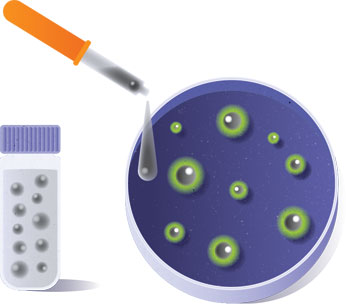
The sample is mixed with silver nanoparticles that naturally glow (fluoresce) when illuminated with a fluorescent gel reader. These nanoparticles act as tiny light beacons, producing a bright fluorescent signal unless something disrupts them.

If the target pathogen’s DNA is present, the CRISPR-Cas enzyme becomes activated and destroys the fluorescent nanoparticles, causing the fluorescent signal (the light) to disappear. If no pathogen is present, the nanoparticles remain intact.
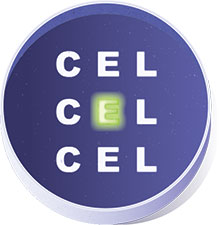
To make detection more intuitive, the researchers reverse-engineered a “signal-on” paper test. Paper cutouts shaped like letters (E, C and L) correspond to different pathogens (E for E. coli., etc.) If the letter glows, that pathogen is present.
Reporting by Erin Frick | Illustration by Kotryna Zukauskaite
Foodborne pathogens such as E. coli, Campylobacter and Listeria can contaminate food long before anyone knows they’re there, and when consumed, they can cause severe and life-threatening illness. Current testing methods often take days to deliver results. “Our lab is working to develop quick, cheap and easy methods to detect foodborne pathogens, which make people sick and cause massive food waste,” says Emmett Hanson ’26, a recent graduate and former chemistry major in professor Mehmet Yigit’s lab, where they used the gene-editing technology called CRISPR-Cas and fluorescent silver nanoparticles to develop a fast, simple and inexpensive paper test. The research led to two published scientific papers, and gave Hanson an invaluable laboratory experience that helped launch him into a PhD program at Stanford.
The hope is that this cheap, quick and easy technology can become commercially available to make real improvements in food safety and public health. Professor Mehmet Yigit is encouraged with the potential impact of his team’s research: “We hope this technology can one day strengthen our food safety systems by detecting harmful pathogens before food reaches consumers.”
Researchers begin with bacterial DNA (a stand-in for the contaminated food sample), which labs can purchase ready-made for research applications. They program the CRISPR-Cas system to recognize the genetic fingerprint of specific foodborne pathogens, such as E. coli.
The sample is mixed with silver nanoparticles that naturally glow (fluoresce) when illuminated with a fluorescent gel reader. These nanoparticles act as tiny light beacons, producing a bright fluorescent signal unless something disrupts them.
If the target pathogen’s DNA is present, the CRISPR-Cas enzyme becomes activated and destroys the fluorescent nanoparticles, causing the fluorescent signal (the light) to disappear. If no pathogen is present, the nanoparticles remain intact.
To make detection more intuitive, the researchers reverse-engineered a “signal-on” paper test. Paper cutouts shaped like letters (E, C and L) correspond to different pathogens (E for E. coli., etc.) If the letter glows, that pathogen is present.