
The election night watch party in Albany heralded a new era. Throngs of supporters of every age and stripe stood shoulder to shoulder waiting for the city’s first Black mayor-elect amid the pulsing of hip-hop music, against the backdrop of a mahogany-walled establishment once frequented by politically powerful white men.
Dorcey L. Applyrs MPH ’05, DrPH ’14, arrived at 9:45 p.m., as well styled and polished as a fashion model (a petite one). She said things no predecessor could: The 44-year-old told her two young children, ages 4 and 7, “Mommy loves you.” She thanked her husband, Don Applyrs ’03, MS ’06, calling him “my chocolate drop.” She rallied admirers with a call-and-response that drew on a phrase popularized by a rapper.
“Tomorrow, we move forward on a new path together,” Applyrs said. She called out, “Ten toes …” And the crowd roared back, “DOWN!”
Albany’s new mayor-elect ended with, “I love you, I love you, I love you, I love you. And I will always fight for you.”
She brought the house down.
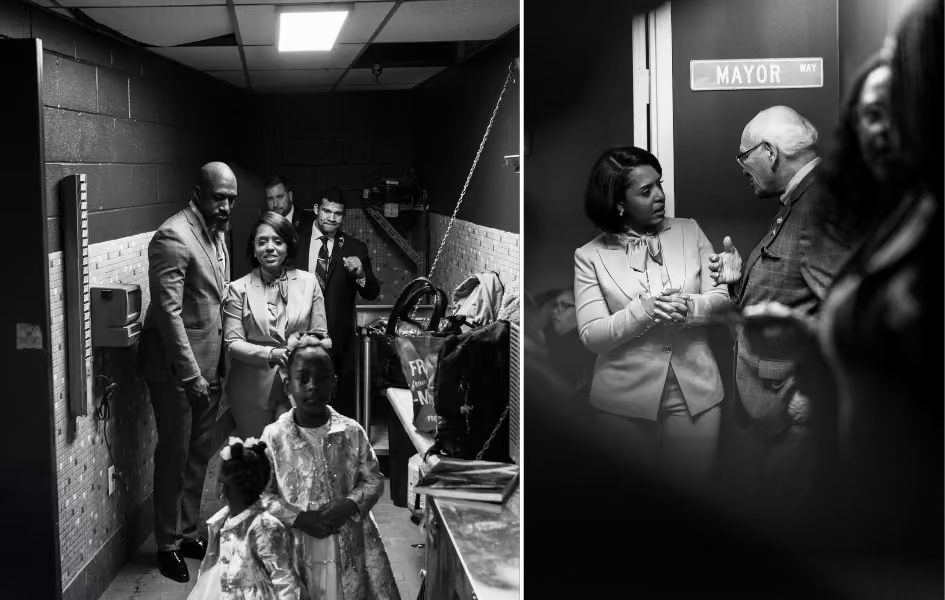
It was not the performance of a natural-born politician, one who has long coveted the power and prestige of office. Indeed, Applyrs admits to being dragged into politics, converting to it as a necessary means to change. Neither politics nor Albany were in the vision of a younger Applyrs, a native of Washington, D.C., with a Southern heritage, who was eyeing Atlanta.
But as fate would have it, a mentor at Delaware State University, where she earned her bachelor’s degree, introduced her to DSU alum Dwight Williams, a clinical professor and director of the undergraduate public health program in the University at Albany’s School of Public Health, now the College of Integrated Health Sciences located on the Uptown campus. Williams facilitated a scholarship to UAlbany for young Dorcey Jones.
“If it was up to me, I was still going to Atlanta,” Applyrs said in an interview a month after election night, at her home in the Arbor Hill Historic District–Ten Broeck Triangle. “My mom said, ‘You’re going to Albany. Because one, they offered you money. And two, I know that Mr. and Mrs. Williams will take good care of you.’”
.avif)
During her victory speech, Applyrs declares, “Tonight, we made history!”
Applyrs initially found Albany cold, literally and figuratively. It was hard to meet people. She lived alone in a studio apartment while pursuing her master’s degree. She’d moved from a city that was about 60% Black to one that was, then, about 60% white.
“It’s just culturally different from D.C. — ‘Chocolate City,’” she said. “This was a very different look and feel I’m not familiar with. It was tough for me.”
A shift came in her second semester. She met Don Applyrs at Sneaky Pete’s, a flashy nightclub that wasn’t her usual scene. She stood out in the crowd, dressed unlike the others, in a classy button-down blouse and nice jeans, Don said. But when he asked her to dance, she turned him down. He waited and asked again.
“We got on the dance floor — and he can really dance,” she said. “We danced for the rest of the night.” She had a two-year plan for Albany then. She and Don stayed together while she completed her master’s and as she applied to doctoral programs everywhere else. The applications were rejected. But in one of her last classes, she met the head of the Capital District African American Coalition on AIDS (CDAACA), who was impressed with her final project and hired her to be the organization’s director. The work was Applyrs’ passion, “the anchor to keep me here,” she thought.
But the work also triggered her own trauma. Her father had died of HIV when she was 5.
She decided again to leave — back to D.C. or to Atlanta at last. Then her pastor at Metropolitan Church, also a transplant to Albany, said, “Dorcey, sometimes you just gotta grow where you’re planted.” Don had already become a rock to her in Albany. And she had found community at church.
She bought a house and started a new job, deciding to plant roots. And then she got fired. Her job search landed her at the Harm Reduction Coalition in New York City. Don helped her move to Harlem, and he moved into her house in Albany. She traveled across the country for two or three years, when a D.C. contact asked her to apply to a public health job there — the gravitational pull of her hometown ever so strong.
Though she had by then applied to UAlbany’s public health doctoral program, she told Don she planned to make her way back to D.C. He had just been promoted to principal of an Albany charter school. So he did the thing he’d been thinking about: he proposed. And she got into the doctoral program. And so: Albany. Home.
Meanwhile, Albany Democratic leaders looking to diversify city leadership were noticing her. They saw her working and giving time to nonprofits advocating for people on the social margins. In the early 2010s, city Democrats Judith Mazza and Dominic Calsolaro convinced her to run for City Council, and Applyrs got her education in neighborhood canvassing. She and a “bunch of young Black and brown girls” she’d recruited from UAlbany learned how on Mazza’s front porch. It was “boots on the ground,” as Applyrs continues to describe her brand of politicking, door to door.
She served on the council from 2014 to 2020, then was elected city auditor. Through those campaigns and her run for mayor, she won over people one by one, neglecting no neighborhood. Supporters extol her ability to listen and to connect. They describe being seen by her.
“Talk to her for 10 minutes, and she’s got you,” Mazza said.
Other leaders could see Applyrs’ emotional intelligence early on, her deep need to serve, said former SPH Professor Dr. Mary Applegate. They saw Applyrs’ experience growing up in a working-class Black community, of witnessing her father’s struggles with substance use and having family role models in public service (Applyrs’ mother was a police officer).
Applyrs’ predecessor, Kathy Sheehan, a Midwestern native, said the new mayor represents an increasing number of Albany residents who come from somewhere else, including immigrants. The centuries-old city where people have lived for generations is now only about half white — close to majority minority, if not there already.
“That is really the path that you have to navigate: understanding those who have a long history of being engaged and involved — listening to those voices — and also making sure you are being the mayor for the future state of the city of Albany,” Sheehan said.
“I am focused on being the mayor of Albany, hands down.”
As Albany’s leader, Applyrs faces big challenges. The former city auditor listed a structural budget deficit as her first priority. Residents also express concerns about safety and affordability. And she has vowed to “make Albany fun again.”
And, of course, there’s politics. Political careers in Albany are often built on well-established alliances, with influence in the hands of familiar names. Applyrs said she is relying on the guidance of a fresh team she has assembled, and the community coalition she has built.
Perhaps ironically, it’s politics that is already giving her some national visibility. In the airport the day after the election, she picked up an unexpected call — from former Vice President Kamala Harris. “I wanted to — pass — out,” Applyrs said.
“I am focused on being the mayor of Albany, hands down,” she added. “But also, if I look at my track record here, I do not close off this notion that there is a potential for other things down the road.”

Applyrs’ swearing-in on Jan. 1 at the Empire State Plaza Convention Center had all the dignity and convention of a formal ceremony, with touches that highlighted community inclusion. An original poem recited by fellow UAlbany alum D. Colin MA ’12 drew gasps and cheers at its litany of names and neighborhoods significant in the history of the city’s Black residents. Applyrs acknowledged her non-native status and the tension that can exist between Albany’s generations-old families and the city’s relative newcomers. The once-reticent outsider committed to creating a new Albany that will attract more people to call it home. She gave a shout out to alma mater (“It’s a great day to be a Great Dane!”) for helping to keep her here.
“Don and I chose Albany, although sometimes I joke that the city chose me — because it kept reeling me back in, even when I wasn’t sure what I wanted to do. Maybe some of you have experienced that and had a similar experience,” Applyrs said.
“There is a pull that this city exerts on your heart and your soul.”